

Do Substack Leaderboards Even Matter Anymore?
Two successful writers hate them. I used to love them. Here's what I learned after being on and off those lists for months.

Yesterday, I was sleepily scrolling through Substack when something made me stop. A Note from Rachel Karten.
“I hate my relationship with the Substack leaderboard and think it turns writing into a competitive sport that mimics the algorithms many of us are trying to escape by writing here.”
Then she added a quote from Alison Roman who left Substack entirely:
“I hate the leaderboard stuff, it gives me so much anxiety.”
Two successful writers. Same problem. Two different solutions: one fights it, the other quits.
But what if there’s a third way?

A few months ago, I wanted to pop champagne when I first saw my name on the leaderboard. It felt like an achievement. Yes, like winning a competition.
I’m a maximalist type—working on managing that part of myself—and the leaderboard brought it right to the surface. Back then, I didn’t understand that this is exactly what it’s designed to do. It’s nice to say the leaderboard “helps with discoverability and visibility,” but the reality? It’s designed to make you want to climb higher. To push yourself so your name appears there again and again.
And that’s when I started seeing what these writers see now: the leaderboard does exactly what it was designed to do. But that’s precisely the problem.

Let me break this down, because understanding the mechanics helps you see why it affects us the way it does.
Substack has two types of leaderboards:
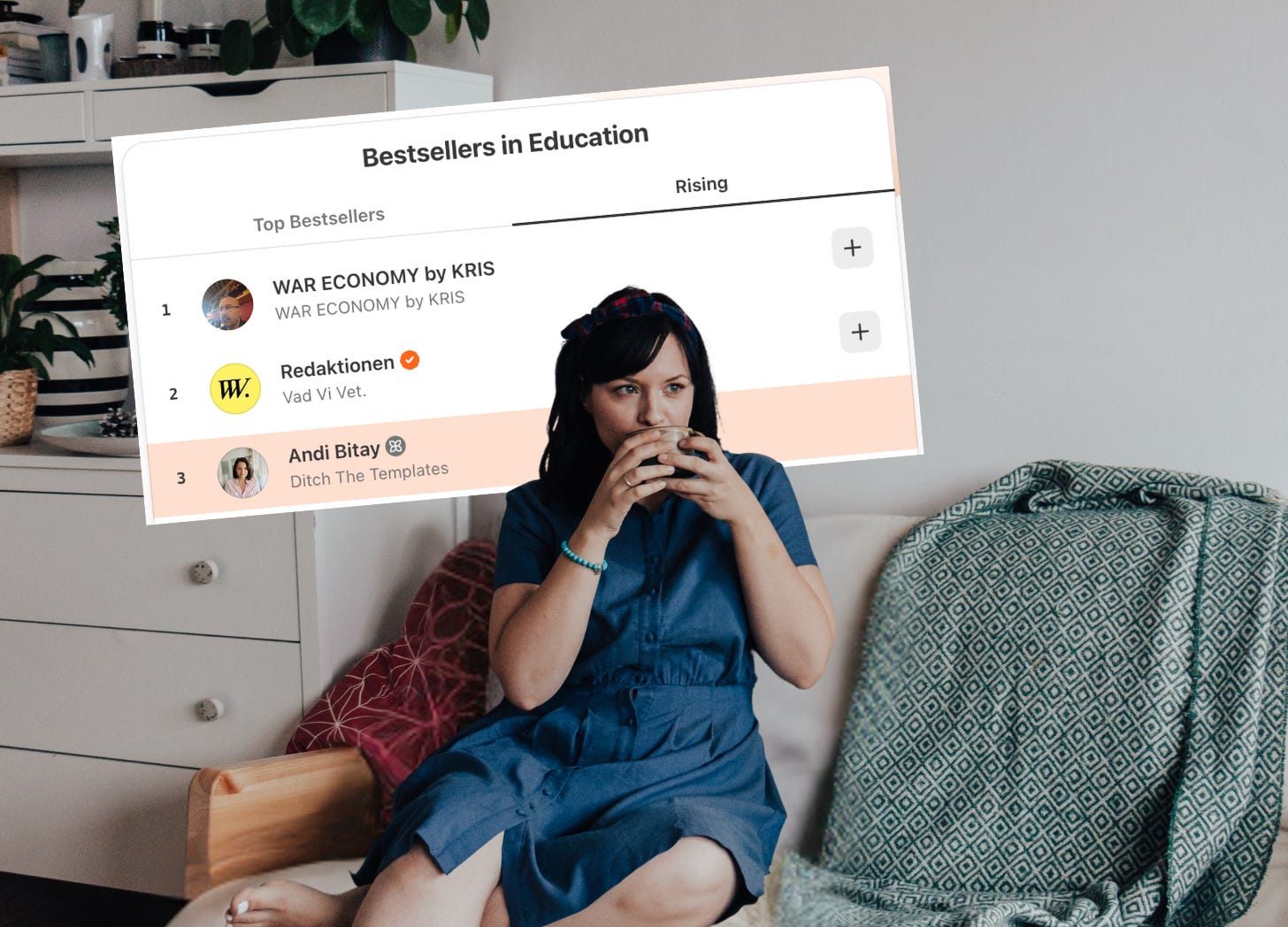
Rising shows the fastest-growing publications in each category, based on paid subscription growth. It updates daily now, though it used to refresh every few hours, which was absolutely wild.
Top Bestseller highlights the highest-earning publications, ranked by Annual Recurring Revenue (ARR).
Sounds reasonable, right? Discovery. Recognition. A way for readers to find great writing.
But here’s what they don’t tell you upfront: the “Rising” list isn’t about who writes best. It’s about who has momentum right now. Who ran a discount campaign this week. Who had a viral Notes post yesterday. Who happened to hit publish at the exact right moment when the algorithm gods were smiling.
The Top Bestseller list? It’s usually the same names, week after week. There’s no middle ground. No real nuance. And here’s the kicker: we came to Substack to escape this. To get away from hourly metrics, algorithmic anxiety, and turning writing into a numbers game.
Yet here we are, refreshing a leaderboard that updates every day on a platform built for slow, thoughtful content.
The irony isn’t lost on me.

Let me be honest about something: the leaderboard works because it’s supposed to work. It taps into everything content creators struggle with.
FOMO. When you see someone rise, you wonder what they’re doing that you’re not.
Social proof. That little badge on your profile that says “#23 Rising in Business” gives you credibility, even if you know it’s just because you ran a sale yesterday.
Validation. After months of writing into the void, seeing your name on a list feels like proof you’re doing something right.
Comparison. You can’t help it. You see who’s above you. Who’s below you. Who dropped off. Who’s climbing faster.
This is what the leaderboard brings out in us—the worst parts of being a content creator. The competitive streak. The envy. The pressure to perform. The need to keep climbing.
I felt all of this. The jealousy when I saw others on the list and I wasn’t. The euphoria when I made it. The anxiety when I dropped off. The constant checking.
And I realized: this is exactly what we fled from on other platforms. We came to Substack for something different. For a space where we could focus on the work, not the metrics. Where quality mattered more than virality. Where we could build slowly and sustainably.


As a content strategist and mentor, I work with Substack writers every week. I read their work. I watch them build, publish, refine, and grow.
And here’s what I know: some of the most brilliant writers I’ve worked with will never appear on a leaderboard.
Not because their work isn’t good enough. But because:
Their niche is too specific for a broad category ranking
They don’t paywall their content
They’re building consistently but not explosively
They write for a smaller, deeply engaged audience rather than chasing growth
They’re in a category so saturated that being top 100 when there are 500 equally good publications is mathematically impossible
I’ve seen newsletters with 100 paying subscribers that provide more value than some with 1,000. I’ve read posts that deserved to go viral but didn’t because timing, luck, and the algorithm didn’t align.
The leaderboard doesn’t measure quality; it measures momentum. And momentum isn’t always correlated with depth, insight, or impact.
Recently, I started a thread in my Chat asking subscribers to share what they write about and link to the post they’re most proud of. The response was overwhelming. Poets. Essayists. Researchers. Educators. Each one doing deeply meaningful work. Some with hundreds of subscribers, some with dozens.
I kept thinking: this is what discovery should look like. Not a ranking based on who sold the most subscriptions this week, but a space where people can show their best work and find their people.

So here’s where I land after all of this: the leaderboard isn’t going away. Substack won’t remove it, and honestly, for some writers, it’s motivating and helpful.
But you can choose not to let it define you.
Find your own measure of success. What does “doing well” mean to you? Is it the number of meaningful conversations you have in the comments? The emails from readers saying your work changed something for them? The fact that you’ve published consistently for six months? Define it for yourself, not by the platform’s metrics.
Take the screenshot and move on. If you make it onto a leaderboard, celebrate. Genuinely. Screenshot it, share it if you want, feel proud. Then close the tab and go back to your life. Don’t tie your worth to a number that changes based on who else launched a campaign today.
Follow the small writers. The best voices aren’t always on the lists. In fact, most aren’t. Seek them out. Read deeply. Subscribe to publications with 50 subscribers that make you think differently. That’s where the real discovery happens.
Build community, don’t compete. The thread I mentioned? That’s the antidote to the leaderboard. When your subscribers introduce each other, when you celebrate other writers’ work, when you collaborate instead of compare—that’s when you remember why you started writing in the first place.
Turn off the notifications. If seeing “You’re rising!” gives you a dopamine hit that makes you check your ranking compulsively, disable it. Protect your mental space. You’re allowed to opt out of the game.
I love Substack. Truly. The platform has given me a business, a community, and a space to write without compromising my voice. The Substack Post does an amazing job curating voices and highlighting writers who deserve attention.
But when leaderboards create more anxiety than the algorithms we fled from, maybe it’s worth asking: do we need this? Is this the kind of discovery we want on a platform built for thoughtful writing?
I don’t have the answer for Substack. That’s not my job.
But I do have an answer for you: you get to decide what matters. You get to choose whether you play this game or build something else entirely.
The work that lasts isn’t the work that rises fastest.
That’s the third way. Not fighting the system or quitting the platform. Just choosing what you measure, and who you write for.
And if that happens to land you on a leaderboard someday? Great. Take the screenshot. Then get back to work.
What’s your relationship with Substack leaderboards? Do they motivate you or stress you out? I’d love to hear your experience in the comments.
P.S. If you’re wondering where you stand—what’s working, what needs adjusting, and how to build strategically beyond the leaderboard game—I’ve opened a few early December spots for Substack Audits. I’d love to help you see your publication with fresh, strategic eyes.
I needed this read. I made it to the leaderboard today and got that euphoric feeling. Like finally, I am getting noticed. I took a screen shot and celebrated. Now I need to move on from it because I agree, it’s a way to keep us reeled in. To try and compete to stay on it.
Great advice, Andi. When I started my Substack a few years ago, the leaderboard was everything, or so it seemed. I was never going to make it on to it, and I hated that it mattered to me at the time. I suspended my writing - for other reasons - then came back to Sunstack fairly recently. I have a completely different perspective now. And until I read your post, I had completely forgotten about leaderboards. I can honestly say, I haven't checked it once since I came back, and have no intention to start now.