

Substack Just Told You Where It's Heading. Did You Notice?
A tiny design change that reveals a big shift, and what it means for your growth strategy.

Something changed on Substack recently. You probably didn't even notice.
Open the mobile app and go to any publication’s profile. What do you see first?
It used to be Posts. A clean list of long-form articles, top to bottom. That’s no longer the default.
Now, the first thing you see is Activity — the Notes feed. Short posts, real-time updates, conversations. The long articles are still there, but they’ve been moved to second place (and renamed to Archive, which is awful by the way).
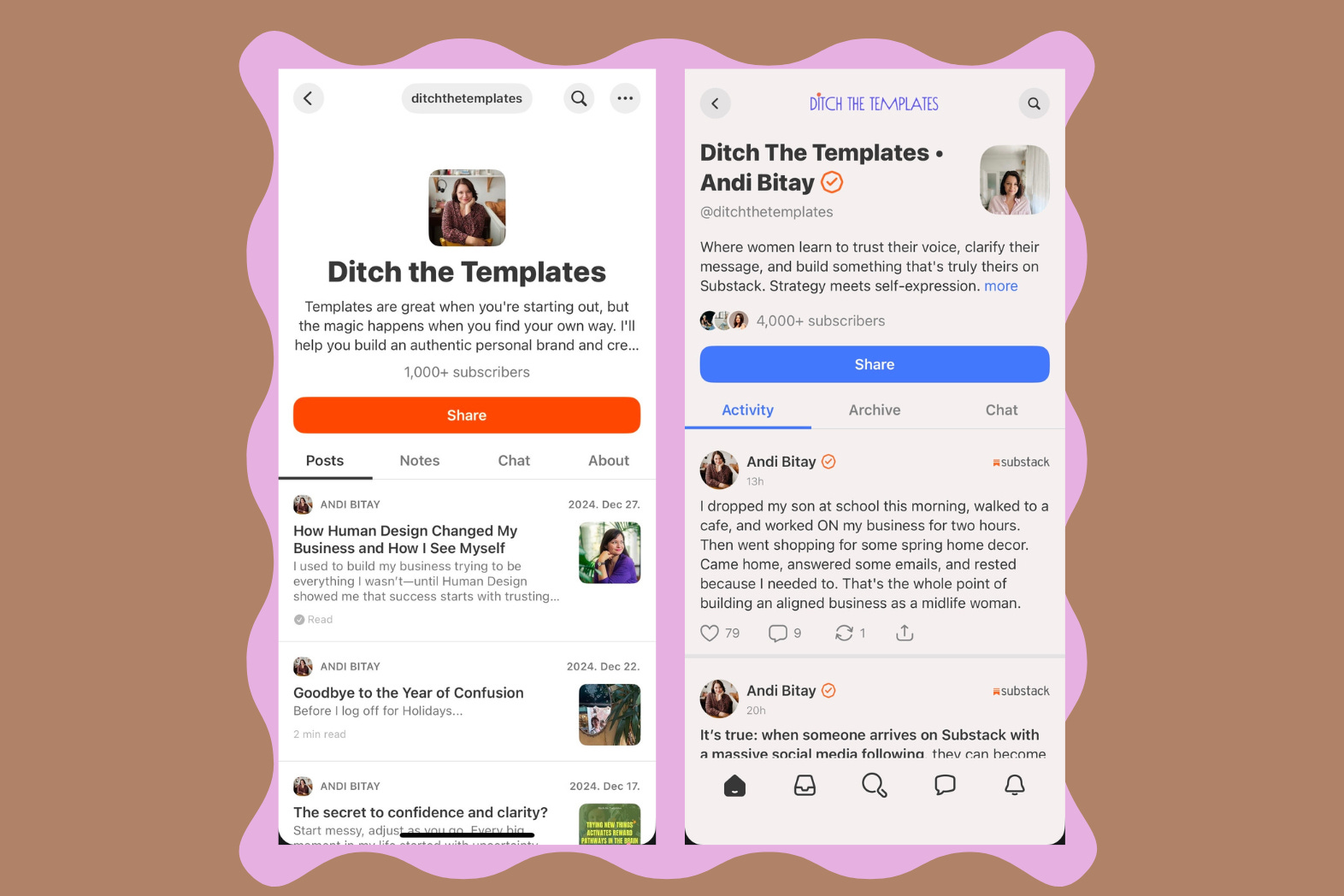
A small UI change? Maybe. But I don’t think Substack redesigns their profile layout on a whim. This is a signal. And if you’re paying attention, it’s a loud one.
Substack is telling you: this is a social platform now. And the people who still treat it like a blog or a newsletter are going to keep wondering why their growth has stalled.
Here’s what I keep seeing
As a strategist, I work with creators and entrepreneurs who've been on Substack for years. Talented people with thoughtful, well-crafted, genuinely excellent posts. And yet their growth has quietly stalled. No new readers coming in, and they can't figure out why.
And then I look at their Notes. The first thing that stands out: they barely use them. And when they do, it's only to share their latest article.
Notes was never meant to be a distribution channel for your long posts. It’s the place where people actually get to know you between the posts.
“But I came here to escape social media”
I hear this constantly, and I get it.
We’re all carrying some version of post-traumatic social media stress at this point. The algorithm anxiety. The dopamine loops. The feeling that you have to perform a shinier, louder version of yourself every single day or you’ll disappear.
So when someone hears “Substack is social media now,” the instinct is to recoil. “Great, another platform that wants me to post daily content and dance for the algorithm.”
But here’s the thing: what gets rewarded on Substack Notes is fundamentally different from what gets rewarded on Instagram or TikTok.
Nobody here cares about your perfectly curated flat lay. Nobody’s impressed by text overlays with bouncing coffee cup stickers. The overly polished, heavily edited, performing-for-the-camera content that works on Instagram? It mostly falls flat on Notes.
What works is honest, simple, and real. A thought you had on your morning walk. A story about something that happened to you. An opinion you actually hold.
That’s it. That’s the whole game.

Three types of Notes that actually perform
I’ve been watching this closely, both in my own account and across dozens of clients. And 3 types of Notes consistently outperform everything else:
1. Storytelling posts.
Who you are. What you went through. How you got here. Where you’re headed. People connect with the arc of a life, not a polished brand statement.
2. Documentation posts.
What you did today. Where you're writing from. The beautiful place you're at right now. What you're working on. How something that just happened made you feel. What's been hard lately. Simple, real things that are easy to connect with.
3. Opinion posts.
A clear point of view. Not a rant, not a hot take for the sake of it, but a genuine perspective on something you care about. The kind of thing that makes someone stop scrolling and think, “Finally, someone said it.”
Everything else is mostly noise. The poetic one-liners, the abstract musings, the long-winded explanations that try to say everything in a single Note, they get lost. And here’s where a lot of people get tripped up: they try to make each Note say something huge. Something complete. Something Important with a capital I.
But your Notes aren’t standalone monuments. They’re connected and the pieces of a bigger picture that builds over time. The question isn’t “Is this Note impressive enough?” The question is: do your Notes, taken together, tell a coherent story? Is there a through-line? A central theme you keep coming back to? Or are you bouncing from topic to topic, hoping something sticks?
So what about the long posts? Are they dead?
Not even close.
Think of it this way. Your long posts are the structure, the walls and the roof that hold everything together. Without them, there’s no house. Notes is everything else: the paint color, the flowers by the door, the warm light in the window that makes someone walking by think, “I want to see what’s inside.” And Chat is the living room where your closest readers actually sit down and stay.
Substack has made this hierarchy cleaner: Notes first (discovery, personality, connection), Posts second (depth, authority, trust), Chat third (intimacy, belonging, retention).
If you’ve been writing beautiful long-form pieces and wondering why new readers aren’t finding you, this might be why. The front door of your Substack has moved. People are meeting you through your Notes now (or through someone else’s Note who shared your content), and then deciding whether to read the deeper stuff.
The daily practice that changes everything
I know what some of you are thinking. “I can’t post on Notes every day. I don’t have that much to say.”
You do. You just haven’t built the habit yet.
Seth Godin has written a blog post every single day for years. He doesn’t treat it as content creation. He treats it as a practice; it’s a way to notice things, collect ideas, form opinions, sharpen his thinking. The writing is the byproduct. The real value is in what it does to his brain.
Notes can be exactly that for you. Three or four sentences about what you noticed today. What struck you. What you disagree with. What you’re working through.
Your inner voice doesn’t only speak up once a week when it’s time to write a polished article. It’s there all the time, processing, reacting, connecting dots. Notes is just the place where you let some of that out.
And here’s what happens when you do: you become a better thinker. A better storyteller. Your long posts get sharper because you’ve been practicing in between. Your readers start to feel like they actually know you, because they do.
The real shift
Substack didn’t just move a tab around. They clarified what they’ve been building toward for a while now: a place where your voice matters more than your production quality, where showing up consistently matters more than showing up perfectly, and where the writers who understand this are going to grow while the ones who don’t will keep polishing posts that fewer and fewer new people ever find.
Look at your Notes. Look at how you’ve been using them (or not using them). And ask yourself honestly: if someone landed on your profile today, with Activity as the first thing they see — what story would your Notes tell them?
Would they want to subscribe?
Warmly, Andi

If you’re looking at your Substack and thinking “I need someone to help me figure this out,” that’s exactly what a Strategic Substack Audit is for. I’ll look at everything — your positioning, your Notes, your pricing, your growth strategy — and give you clear feedback.
The issue I see with this is that the only people who seem to post & peruse notes are other users with publications who want to grow...not the everyday reader account. So your subscribers seem to end up being skewed with other writers and you're hoping within that they may also be an ideal client. I'm not really sure how we're supposed to get infront of the general users without publications...just hope they find us in their searches or occasional notes scroll? I don't think I've had one subscriber yet who doesn't also write on here
Thank you for the helpful info. New people seeing ‘archive’ are likely to think it’s very old stuff and not bother looking ☹️ Could they not have named it ‘articles’ in a sensible manner?